

Perfect Pairs: What Courtship Rituals Reveal About the Big 5
In honour of the month of love, we turn instead to something quieter and far older than sentiment: instinct.
In the wild, courtship is not about grand gestures. It is about timing, awareness, strength, and survival. Each interaction between the Big 5 reveals something essential about how these animals communicate, protect the next generation, and hold their place within this beautiful and oftentimes harsh landscape.
At Leopard Hills Private Game Reserve, these moments are not staged or sentimentalised. They unfold whether or not we observe them, in scent and posture, in signals so subtle you might miss them if you don’t know what to look out for.
Here is what courtship reveals about character in the wild…
Elephants: Presence
Elephants are defined by intelligence and memory, and their mating rituals reflect both. When a bull elephant enters musth, his testosterone levels rise dramatically. Physically, he changes. He carries himself differently, head lifted, ears slightly extended, a dark secretion visible behind his eyes. His scent travels ahead of him.
Yet for all the heightened biology, there is patience in the process. He may follow a receptive female for days, rumbling softly to signal intention. Females assess him carefully. To them, timing and social context matters.
Elephants remind us that strength alone is not enough. Presence must be recognised and accepted within a wider community. Pre-mating behaviour here is negotiation.
Lions: Leadership
Male lions announce themselves long before they are seen. A roar can travel kilometres, broadcasting territory, vitality, and warning to rivals. But volume is not what secures a future.
Lionesses are discerning. They assess stamina, condition, and the male’s ability to defend territory. When a coalition male remains near a receptive female, it is not simply about mating, it is about proving reliability. The survival of future cubs depends on his strength and his willingness to guard them.
In lions, attraction is inseparable from responsibility. Leadership in the bush is measured not by dominance alone, but by the protection it provides.
Leopards: Independence
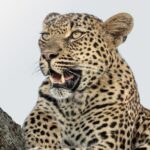
Solitary and self-reliant, leopards come together only when conditions are right. A fertile female signals her readiness through scent markings and vocalisations. A nearby male responds quietly, patrolling, scent-marking, shadowing her movements.
When they meet, there may be soft chuffs, brief playfulness, repeated mating over several days to ensure success. And then, just as quietly, they part ways.
The female raises her cubs alone, teaching them to hunt, to climb and to be as stealthy and as successful a hunter as she is.
Rhinos: Protection
Rhinos communicate largely through scent. When a female becomes receptive, chemical signals alert nearby males. A bull may follow her for days, occasionally sparring with rivals, staying close while she is fertile.
After her calf is born, a female rhino is among the most vigilant animals in the bush. She positions herself between threat and offspring – a fierce protector.
Perhaps rhinos teach us the quiet truth across the wild: courtship may begin the story, but protection sustains it.
Buffalo: Community
Buffalos operate within hierarchy. Bulls test one another through displays of strength like pushing, head-butting and posturing, establishing dominance without unnecessary injury. Access to receptive females comes through rank, but the herd’s cohesion remains paramount.
Females often linger near bulls who demonstrate steadiness rather than volatility. Stability ensures safety and safety ensures survival.
In buffalo society, even the most individual instincts are shaped by what’s best for the herd.
Book Your Big Five Safari
Enquire about your stay in the Sabi Sand Nature Reserve and experience the Big 5 not just as icons, but as complex, strategic, and deeply instructive inhabitants of this remarkable landscape.