

Bush Bulletin – August 2026
With winter officially behind us, we can feel that morning sun warming the day earlier and earlier. We’re packing away the hot-water bottles and gearing up for the summer heat. Much like the temperature, the sightings have also been heating up.
Reunion in the Clearing: A Morning with the Bateleur Pride
by Morné
There is a particular kind of silence that falls over the Sabi Sands just after sunrise the bush still cool, the light still soft, the day’s first calls only beginning to break the quiet. It was into this silence that, on a recent morning drive, we first heard her.
Soft contact calls. Low, almost conversational, drifting across the clearings ahead of us. It was the unmistakable sound of a lioness searching for family.
Following the Calls
We followed the sound for some time, tracking through the mixed woodland as the calls grew nearer and more frequent. Eventually, in a golden clearing lit by the rising sun, we found her: the Bateleur female, moving with purpose, her three young cubs trailing close behind on unsteady legs. She bore fresh scrapes and bruises, clear signs of a run-in during the night most likely a confrontation with a rival pride or a clan of hyenas. The cubs, thankfully, were unharmed.
She was not simply moving she was calling. And she was calling to someone specific.
A Daughter Answers
Somewhere out in the bush, her call was being answered. The Bateleur female was searching for her elder daughter, a young lioness of roughly three to three and a half years old from a previous litter, now living on the fringes of independence but still tied, as lions so often are, to the sound of her mother’s voice.
When mother and daughter finally came together in the clearing, what followed was nothing short of extraordinary. The two lionesses stood close, heads raised, and began to vocalise together a duet of deep, resonant calls carried out across the still morning air. It was, unmistakably, a reunion.
But it was also, we sensed, a search. The Bateleur female’s other daughter – this young lioness’s sister from the same litter – was nowhere to be found. The calling continued, deliberate and unhurried, mother and daughter working together to reach a member of the family still missing from the group.
Little Voices Joining In
Perhaps the most heart-melting part of the sighting came from the three small cubs. Too young to understand the gravity of the moment, too young even to properly call, they pressed in close behind the two grown lionesses and did their best to join the chorus with small chirps and half-formed calls, their voices not yet capable of the deep contact calls of the adults, but trying all the same.
We sat with the pride for several minutes as this played out: two lionesses calling into the morning for a missing daughter and sister, three cubs adding their tiny, determined voices to the effort, all of it framed by the crisp light of a Sabi Sand sunrise.
It was a privilege to witness a quiet, powerful reminder of just how deeply connected lion families are, and how far their bonds reach, even across the vastness of the bush.
A Rare Night Encounter: The Porcupine
by Johan
There are some moments on safari that remind you just how unpredictable and special the African bush can be. While most game drives bring us in search of lions, elephants, leopards and other iconic wildlife, sometimes it is the quieter, more unusual encounters that stay with you the longest.
One such moment came on a recent night drive when we came across this magnificent porcupine moving through the darkness.
Briefly illuminated by the spotlight, its quill-covered body seemed to almost glow against the night. With its distinctive black-and-white quills raised high, it looked every bit as impressive as its reputation suggests. Watching it slowly forage along the ground, completely unconcerned by our presence, was a privilege.
Porcupines are Africa’s largest rodents, yet they are surprisingly elusive. They are primarily nocturnal, spending the daylight hours hidden away in burrows, rocky shelters or dense vegetation. This means that seeing one out in the open on a night drive is always something special.
And what an incredible animal it is. Those quills are its most famous defence, but contrary to popular belief, a porcupine cannot shoot its quills. When threatened, it can raise and fan them out, making itself appear much larger and presenting a formidable barrier to any predator brave enough to come closer.
As we sat quietly watching, the porcupine continued about its business, sniffing through the leaf litter and searching for food. These seemingly simple moments are often the ones that make a safari so rewarding. There is no dramatic chase or roaring lion, just a fascinating wild animal going about its nightly routine.
For me, encounters like this are a reminder that the bush is about so much more than the Big Five. Every night brings the possibility of discovering something unexpected.
And on this particular night, we were fortunate enough to spend a few precious minutes in the company of one of Africa’s most fascinating and elusive rodents.
A porcupine in the spotlight. A quiet night in the bush. And another unforgettable safari memory.
Little Spots
by Michael
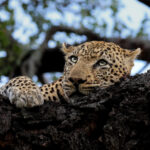
With springtime officially starting, it’s a wonderful time in the bush. Migratory birds are returning, flowers are starting to pop up, the weather is taking a turn for the better, and general life in the bush is just flourishing, including our “bigger” animals, just like Mahetelelo’s cub…
Mahetelelo is known to be quite an elusive leopard. Whenever you think you’ve got eyes on her, she disappears. That behaviour hasn’t changed in the slightest since she’s had her little one.
However, every now and then, you get spoiled with a sighting that will be engraved in your mind forever.
Just like this particular sighting we had less than a mile from the lodge when Morne and I came across her and the cub feeding on a female Nyala carcass.
Naturally, this had us all filled with excitement. We hadn’t seen the cub in a good couple of weeks, and we all know the harsh elements that they face out in the bush, so we were extremely relieved when we saw her. It was great seeing the cub feeding on meat, which is essentially laying out a strong foundation for a cub’s success.
Even though there’s still a long road ahead to ensure this little one’s survival, she is doing well and going strong…
Low-key Buffalo
by Justin
There are certain animals in the bush that seem to live by one very simple philosophy: if you can make yourself comfortable, why on earth wouldn’t you?
This particular gentleman had certainly taken that philosophy to heart. While enjoying an afternoon from the restaurant deck, our guests noticed an old Buffalo Bull wallowing in the camp pan. Naturally, there was only one thing to do forget the afternoon drive route and go and see the buffalo!
And who could blame them? This was a proper old Dagga Boy, complete with enormous horns, a weathered face and the wonderfully grumpy expression that seems to come standard with an old buffalo bull.
The term Dagga Boy is commonly associated with mature male buffalo that spend much of their time away from the breeding herds, often associating with other bulls or becoming more solitary. They also have a particular fondness for wallowing, especially during the warmer parts of the day. And while it may look like this old boy was simply enjoying a rather filthy afternoon bath, wallowing is an important part of buffalo maintenance. The cool mud helps regulate their temperature and can provide some relief from biting insects and parasites.
As if the mud wasn’t enough, he had even brought along his own spa attendants. Several Oxpeckers were busy clambering over his back, making the most of the ticks and other parasites that buffalo provide. A rather impressive example of teamwork although I’m not entirely sure the buffalo had been given a choice in the matter!
When we pulled up beside the pan, he barely acknowledged us. No dramatic reaction, no hurried escape and certainly no indication that our arrival was worthy of interrupting what was clearly a very important wallowing session. He simply looked at us with that unmistakable buffalo expression:
“Yes? Can I help you? I’m rather busy here.” Or “Where’s my money?”
And honestly, I couldn’t argue with him and wouldn’t want to.
There is something special about seeing an old Dagga Boy like this. The scars, worn horns and heavily developed bosses are reminders that this is an animal that has spent many years navigating the African bush. Buffalo may have a reputation for being tough, stubborn and slightly grumpy and, to be fair, they haven’t exactly done much to disprove it, but they are also incredibly resilient and fascinating animals.
For our guests, it became a wonderfully simple start to the afternoon. No chase, no predator encounter and no dramatic interaction just an old buffalo bull enjoying a peaceful afternoon in the mud, conveniently positioned right outside camp.
And perhaps that’s the beauty of the bush. Sometimes, the best sightings are simply about watching an animal doing exactly what it wants to do.
In this case, an old Dagga Boy enjoying his afternoon at the five-star mud spa.
No bookings required.
Stay With Us
If you’re interested in experiencing an awe-inspiring South African safari, please don’t hesitate to get in touch with our reservations desk at book@leopardhills.com.
Alternatively, click here and make use of the quick and seamless online booking process and start planning your ideal vacation today.
We look forward to welcoming you to Leopard Hills Private Game Reserve.