

Bush Bulletin – February 2026
After the dramatic floods of January reshaped our landscape and temporarily altered the rhythm of daily life in the bush, a welcome sense of normalcy has returned to the Western Sector. The roads have dried, the river levels have steadied, and with the bush gradually shifting into its late-summer colours, our sightings have once again found their familiar flow.
While the landscape still bears subtle reminders of the season’s intensity, there is a comforting steadiness in the air, a reminder that in the wilderness, balance always returns.
The Rhythm of the Wild: A Sunset Hunt at Leopard Hills
by Morné
There’s a certain anticipation that comes with a first-ever afternoon safari. The golden light stretching across the bushveld, the hum of excitement in the air, and that feeling of not quite knowing what the wilderness has in store. On this particular afternoon, our focus was set on a pride of three lionesses – a trio we’ve been following closely over the past week as they’ve honed their hunting skills.
With one heavily pregnant female among them, the story promised to unfold in fascinating ways. It didn’t take long to find them, though, true to their nature, the lionesses were doing what lions do best: laying around. Lions, after all, spend close to twenty hours a day in varying degrees of relaxation, and these three were textbook examples. We sat quietly, watching them cuddle, yawn, and stretch, a masterclass in the art of doing absolutely nothing with total confidence.
After half an hour in their company, we decided to give them space and enjoy our own moment of stillness, a perfectly timed sundowner against a burning African sky. A few gin and tonics and glasses of wine later, we returned to the pride as the light faded, knowing full well that with the night, lions truly come alive.
As we arrived back, the lionesses were stirring. They groomed each other tenderly, the final rays of sun painting them in amber tones. Then, movement on the horizon, a small herd of impala, unsuspecting and steadily making their way toward the clearing where the pride rested. You could feel the energy shift instantly. The playful warmth vanished, and purpose took its place.
Two of the females melted into the thickets, their tawny coats blending effortlessly into the bush. The third the pregnant lioness moved with deliberate intent her silhouette framed by the last glow of sunset before vanishing completely into shadow. Then came the stillness, dense and electric, broken only by the night sounds of the Lowveld.
Moments later, the quiet erupted a flurry of alarm calls, followed by the unmistakable, chilling sound of a death bleat. As we lifted the spotlight, a lioness stood just meters ahead, a young impala clasped in her jaws. Within seconds, her sister arrived, and a brief tug-of-war ensued before both were joined by the matriarch. Together, they disappeared once more into the darkness, the symphony of crunching bones and low growls echoing through the night.
It was a perfect reminder of the bush’s rhythm unhurried, unpredictable, and profoundly real. At Leopard Hills, every drive unfolds its own story, and this one reminded us that even the quietest moments can end with the wild’s breathtaking intensity.
Time with a Giant (In the Presence of a Big Tusker)
by Johan
There are moments in the bush that stay with you forever.
Standing quietly in the fading light, watching a massive tusker move slowly through the grass, is one of them.
This old bull, an African elephant carries more than just ivory, he carries time, memory, and presence. His tusks sweep forward in elegant arcs, heavy and worn from decades of digging for roots, stripping bark, and sparring with rivals.
They are not just impressive in size; they are symbols of survival. To see a big tusker like this is to witness history on four legs.
Every scar on his face tells a story. The deep creases around his eye speak of years spent navigating droughts, floods, territorial encounters, and long seasonal migrations.
His slow, deliberate steps shake the earth in a way that reminds you who truly shapes this landscape. Elephants are engineers of the bush opening pathways, pushing over trees, creating clearings, and digging waterholes that benefit countless other species.
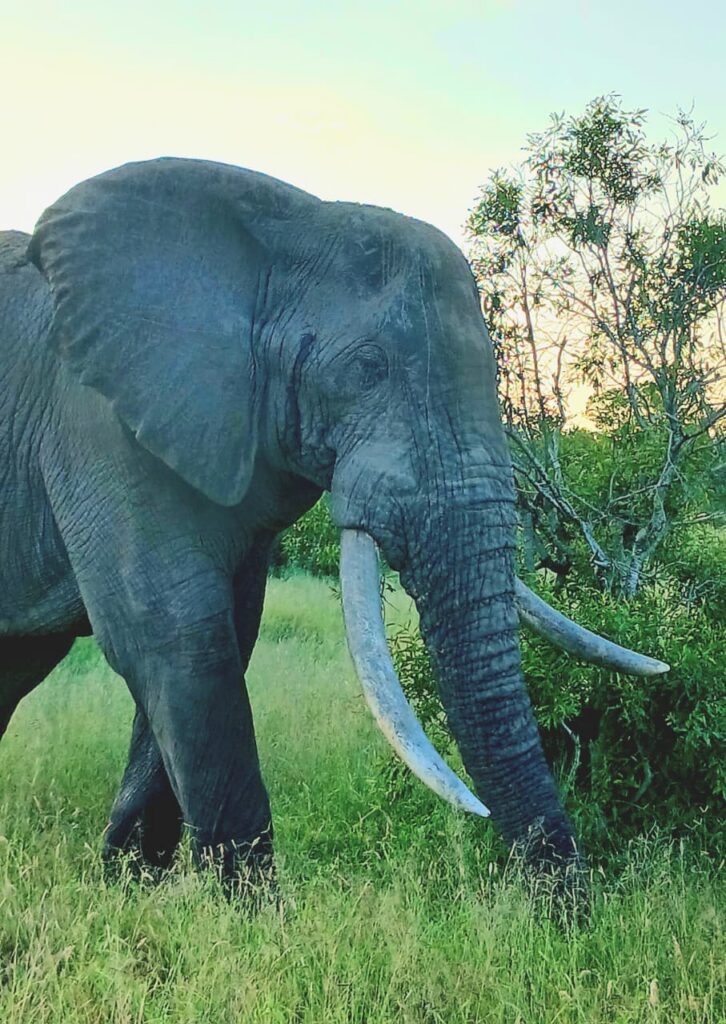
Yet despite his size and strength, there is a gentleness to him. The way he pauses to pull grass with his trunk. The careful swing of those enormous tusks as he feeds. The calm intelligence in his eye.
Spending time with a bull like this is humbling. You feel small – not insignificant – but simply reminded of your place in something much bigger. There is a quiet respect that settles over you. Conversations soften. Movements slow. Even the birds seem to give him space.
Big tuskers are becoming increasingly rare. Age, genetics, and the pressures of the modern world mean that bulls carrying ivory of this magnitude are not as common as they once were. Each sighting is a privilege. Each encounter is a reminder of why wild spaces matter.
As the sun dips lower and the sky turns gold behind him, he fades into the trees as silently as he arrived. The grass sways where he walked. The bush closes around him.
And you are left standing there, grateful knowing you have just shared a moment with one of Africa’s true giants.
Mighty, but not a Mouse
by Justin
Late summer in the bush carries a certain softness where you can feel the heat but sense that it has lost some of its punch. The light is warmer, the afternoons heavy with humidity, and the promise of rain hangs in the air. While the larger predators continue to dominate many of our drives, it was two of the smallest carnivores in Africa that stole the show this month.
On the home stretch after a successful morning drive along the river, we paused beside a fallen marula where a troop of dwarf mongooses had begun their daily foraging. Among them, two youngsters broke away from the group and erupted into what could only be described as an energetic wrestling match.
Dwarf mongooses hold the title of being “the smallest carnivore in Africa”, weighing less than a kilogram, but what they lack in size, they more than make up for in personality. These two excitable individuals tumbled through the dust, biting, wrestling and rolling over each other with loads of drama. While it may look aggressive, this “play fighting” is anything but.
From a behavioural standpoint, play fighting is critical for young mongooses. It helps develop coordination, strength and social bonds within the business (collective noun of the day). It also allows them to practice the skills they will one day rely on when defending territory, competing for rank and responding to threats. Importantly, the interaction remains controlled: no true intent to harm, frequent pauses, and clear signals that the bout is all in good spirit.
What made the sighting so special was the contrast. While we often celebrate the intensity of a hunt or the power of a large predator, here was a reminder that the bush is equally shaped by these small, complex social moments.
As the storm clouds gathered in the distance and the air thickened with the scent of impending rain, the two mongooses finally tired of their contest and scampered back to the safety of their family. In a reserve known for its giants, it was refreshing to be reminded that sometimes the smallest players can make the biggest impression.
The Perfect Leopard Sighting
by Michael
There are few things in this world that we could all agree are perfect. It’s quite the statement to call something perfect, but this leopard sighting could not be described otherwise…
On a very typical Friday afternoon, our drive started out with the usual suspects. Some impala, a couple of zebras, wildebeest and maybe a giraffe or two. Which all have their own spotlight when the time comes. However, this particular afternoon, we were looking for something a little more adventurous than the standard. We set out to see a big cat of sorts, any of which would work just fine with the goal we had in mind, what we didn’t realise was just how special this next part would be.
After tracking a male leopard in the morning with no success, we had news of a possible sighting of a female in the south of the reserve. Interest was low and the sun was setting, but we optimistically took a chance and went looking.
By the time we made it south, she had been located, but the visual was extremely limited. A spot at best…
Because of this, many people decided to move along, but we stayed and waited it out which rewarded us with the best results!
Soon after everyone was gone and it was only us there, she got up and started moving, she started patrolling her territory. We followed her through a thicket which can only be described as mythical, the golden rays of the sun peeking through the treetops lighting her up like a character on stage. After about 30 minutes of exploring what felt like the Amazon, she popped out on a road, walked on it for about two minutes and went up a fig tree. With the sun perfectly placed behind us it was a moment that will be engraved in my mind forever, one couldn’t ask for a more perfect leopard sighting!
We left her soon after and she spent the rest of the evening patrolling her territory. It was just another testimony to how special the Sabi Sand Nature Reserve is!
Stay With Us
If you’re interested in experiencing an awe-inspiring South African safari, please don’t hesitate to get in touch with our reservations desk at book@leopardhills.com.
Alternatively, click here and make use of the quick and seamless online booking process and start planning your ideal vacation today.
We look forward to welcoming you to Leopard Hills Private Game Reserve.